


Tag: NY
New York City lawmakers push sweeping restrictions on private sector biometric surveillance

New York City lawmakers are weighing a sweeping new attempt to curb the spread of biometric surveillance in everyday life, advancing legislation that would sharply restrict the ability of businesses and landlords to collect facial scans, voiceprints, fingerprints, and other uniquely identifying data from the public.
The proposals were the subject of a lengthy hearing this week before the City Council’s Committee on Technology where councilmembers, privacy advocates, and city officials debated whether biometric technologies have quietly expanded into retail stores and residential buildings with little oversight.
At issue were two bills that together would make New York City one of the most restrictive jurisdictions in the U.S. when it comes to private sector biometric surveillance.
The push reflects a growing concern among lawmakers that the technology has moved beyond narrowly defined security uses and is beginning to reshape the way businesses monitor customers and tenants.
Councilmember Shahana Hanif, the sponsor of one of the bills, argued that biometric identifiers present a fundamentally different privacy risk than ordinary data.
“You cannot cancel your face,” Hanif said during the hearing, emphasizing that biometric identifiers cannot be replaced once compromised.
The legislation responds in part to revelations that some retailers have begun experimenting with facial recognition systems designed to identify suspected shoplifters or repeat offenders.
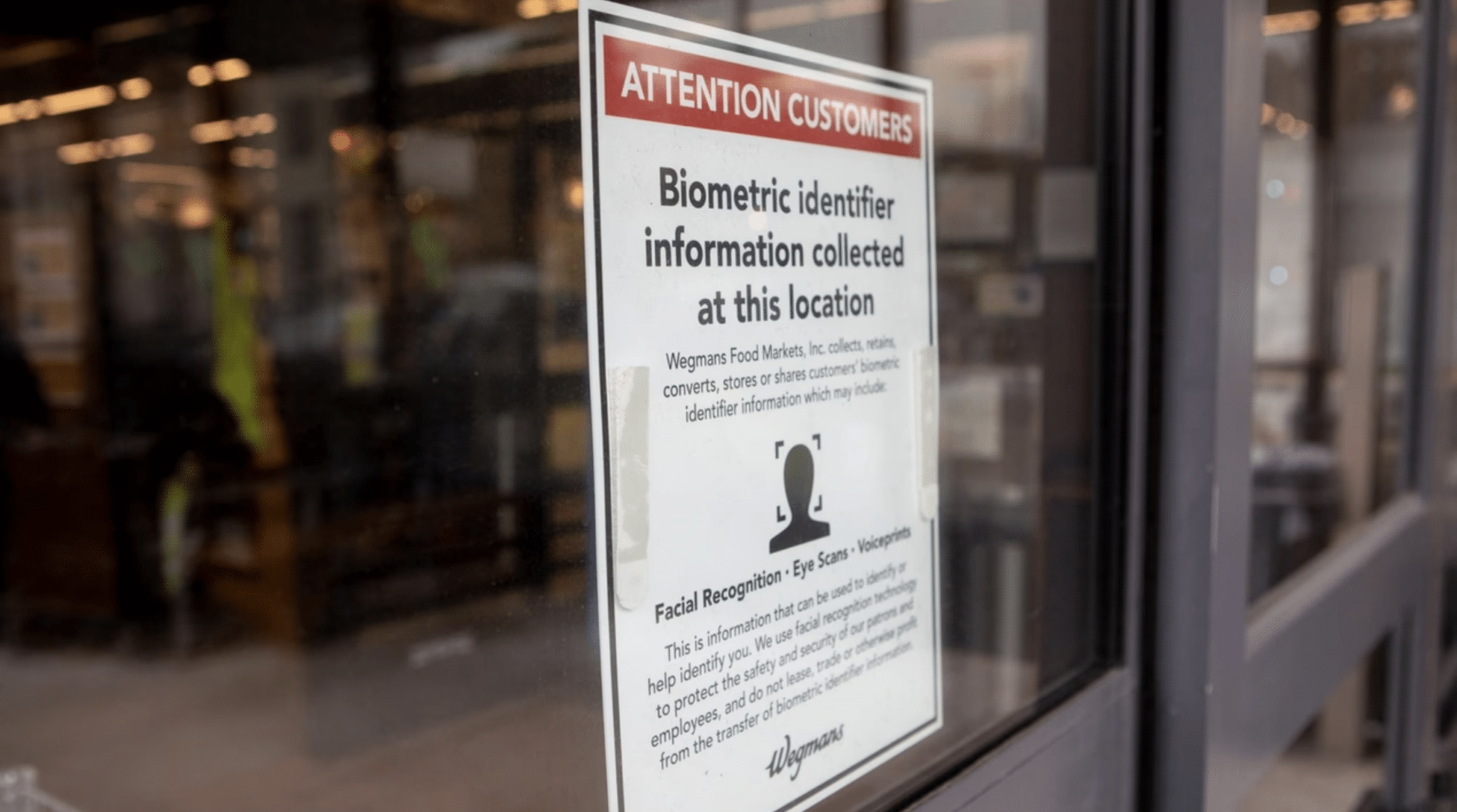
One example frequently cited by lawmakers involves grocery chain Wegmans, which has acknowledged using facial recognition technology in certain locations as part of its loss prevention strategy.
Under the first proposal, businesses that qualify as places of public accommodation would be barred from using biometric recognition technology to identify or verify customers.
The measure would go far beyond the city’s current rules, which mainly require businesses to post signs notifying customers if biometric information is being collected.
The bill would also expand how biometric identifiers are defined under city law. The definition would include not only fingerprints and iris scans but also voiceprints, facial geometry, and even movement patterns that could be used to identify an individual.
A second proposal introduced by Councilmember Pierina Ana Sanchez focuses on residential buildings. It would prohibit landlords from installing or using biometric recognition systems that identify tenants or their guests.
Lawmakers behind the measure say the growing use of facial recognition door entry systems in apartment buildings raises serious concerns about tenant privacy and potential surveillance inside private residences.
Together, the bills reflect a broader shift in the debate over biometric technology.
Earlier efforts in New York primarily focused on transparency, requiring businesses to disclose when they were collecting biometric data. The new proposals instead move toward outright prohibition.
Advocates for the legislation say that shift is necessary because disclosure alone has done little to slow adoption.
Civil liberties groups have warned for years that biometric surveillance systems can enable continuous tracking of people’s movements and associations.
Once deployed in retail stores or apartment buildings, they argue, such systems can quietly build databases of people who have done nothing wrong.
The debate gained additional momentum following several high-profile incidents in New York. In one widely publicized case, Madison Square Garden used facial recognition to identify and deny entry to lawyers affiliated with firms that were involved in litigation against the venue’s owner.
The incident highlighted how biometric tools could be used not just for security but also for private blacklisting.
At the same time, retailers have argued that biometric tools are becoming increasingly important for security as organized retail theft has grown more sophisticated.
Companies deploying the technology say facial recognition allows them to identify repeat offenders and prevent theft without requiring constant manual monitoring by security staff.
That argument did not persuade many councilmembers at the hearing, where lawmakers repeatedly pressed city officials and industry representatives about the risks of misidentification and data misuse.
The hearing also revealed gaps in the city’s own understanding of how biometric technologies are being used.
During testimony, representatives from the New York City Office of Technology and Innovation (OTI) acknowledged that the city does not maintain a comprehensive inventory of biometric data collection across agencies.
Alex Foard, OTI assistant commissioner of research and collaboration explained that the office only tracks certain technologies reported under Local Law 35, a 2022 New York City regulation requiring city agencies to annually disclose their use of automated, AI, or algorithmic tools that impact the public.
That disclosure system though does not capture every instance in which biometric data may be collected or stored. Some uses may fall outside the reporting framework, meaning that even city officials cannot fully account for how the technology is deployed across government.
“I do want to indicate that agencies could be using biometric data in ways that aren’t involved in algorithmic decision making or AI or other uses, in which case we would not have visibility into that collection,” Foard said.
The lack of clarity troubled several councilmembers, who argued that if the city government itself cannot fully track biometric technologies, it becomes even harder to regulate their use in the private sector.
The Office of Technology and Innovation did not take a formal position on the proposed bans but acknowledged the complexity of regulating rapidly evolving surveillance tools.
In written testimony submitted to the committee, the agency said it supports efforts to strengthen privacy protections while ensuring that legitimate uses of technology can still be evaluated carefully.
The debate also reflects a broader national trend. Across the U.S., lawmakers are grappling with how to regulate biometric systems that can identify people automatically through cameras, microphones, or other sensors.
Many of the existing laws focus on notice and consent requirements, requiring companies to disclose when biometric data is collected. Illinois’ Biometric Information Privacy Act, for example, requires written consent before companies can gather biometric identifiers.
New York City already has a limited version of that approach. Current city law requires businesses that collect biometric information to notify customers through posted signs, but it does not prohibit the practice itself.
Supporters of the new legislation argue that those transparency requirements have proven insufficient. They point out that most consumers either do not notice the signs or do not understand the implications of biometric tracking systems that can log and analyze their movements across multiple visits.
Opponents, however, warn that an outright ban could create unintended consequences.
Retail industry groups say the technology can help prevent theft and improve security for both employees and customers. Landlords have also argued that biometric entry systems can be more secure than traditional key fobs or passcodes, which can easily be copied or shared.
Still, the political momentum in New York appears to be shifting toward stronger restrictions.
Privacy advocates argue that facial recognition and similar tools create the infrastructure for constant monitoring, allowing private actors to track people’s movements through stores, apartment buildings, and other everyday spaces.
For councilmembers pushing more restrictive legislation, the stakes are about more than just consumer privacy. They see biometric surveillance as a technology that could fundamentally alter the relationship between individuals and the spaces they inhabit, turning routine activities such as shopping or entering one’s apartment building into moments of automated identification.


