


A plastic spoon's worth of tiny fragments, quietly accumulating inside the human brain. That image is no longer science fiction....
Known, documented and ignored: Confronting the international politics of inaction
When the world documents harm but choose not to act, it allows conflict, repression and human suffering to persist.
The post Known, documented and ignored: Confronting the international politics of inaction appeared first on THE ETHICS CENTRE.
Ghost Murmur whispers the arrival of zoemetrics

By Professor Fraser Sampson, former UK Biometrics & Surveillance Camera Commissioner
There are two things about biometrics that make it an endlessly evolving discipline: our signatures of humanity and our ability to track them. The UK’s National Cyber Security Centre defines biometrics as “the automated recognition of individuals based on their biological and behavioural characteristics.” The reach of that automation is expanding rapidly as technology reveals new indicators of personhood and unlocks our capacity to detect them reliably and remotely.
In the latest feat of biometric virtuosity to make the headlines, US forces deployed what some sources called “never-before-used technology” to locate and rescue a downed airman from an Iranian mountain region. The ‘Ghost Murmur’ tool was described by several news outlets as futuristic but – a bit like the plots in dystopian fiction – the actuality is already here.
Biometric technology is unlocking so many modalities (things that we can measure like fingerprints, faces and DNA) that, as I have suggested elsewhere, we are entering the field of zoemetrics where every manifestation of life can be weighed and weighted. While we can attach transmitters to inanimate objects like golf balls and surfboards (although, astonishingly, not yet vehicles), the wonder of zoemetrics is that we are all emitting natural signals all the time, many of them unique to us – and their traceability is blooming with our ingenuity. AI-enabled technology is giving us ever more imaginative ways of calibrating human life and zeroing in on features of individual biological uniqueness that can distinguish us from everyone else. As modalities like voice and pulse recognition have shown, once you can isolate and reliably compare a set of variables for congruence with a pre-determined pattern, you get confirmation of identity which is the grand prize for security, forensics and criminal investigation.
Given the saturation of technology in our ‘expository society’, it’s not surprising when people are found by advanced surveillance capability even in remote settings, but locating a lone human soul so quickly in a vast and unpeopled landscape is still a remarkable feat.
In a dynamic military context, the delay from flash to bang can be short but in law enforcement the latency is different; the policing environment presents a different type of battlefield. Introducing groundbreaking technology can be frustrating and the path from innovation to implementation is often labyrinthine and laborious. A decade after its initial adoption, UK policing is still anguishing over facial recognition technology, with front-line teams perplexed at why their organisations haven’t introduced technology that their teenage offspring are already bored with. While retail businesses are pioneering the sustainable benefits of live facial recognition (LFR) for preventing crime, the police still give advance notice of the few sites where it will be in use so that individuals can ‘opt out’ of being found by it.
By contrast, the take up speed for crime-enabling technology is almost instant and the life cycle from breakthrough-to-bin is as long or as short as opportunity dictates. With the only entry requirement being technical possibility and few, if any, barriers to adoption, the return on investment for the criminal use of biometric technology is a steal. AI-powered technologies are expanding the reach of individual and organised criminals and some of the biggest risks to our communities won’t be prevented by posting a constable at the gates. The availability of Deepfakes-as-a-service is an example of where the impact of AI-enabled technology on the criminal justice system has yet to be understood while the use of drones, molka surveillance, doxxing and swatting is growing.
With so many political pronouncements appearing in all caps braggadocio, genuine claims for innovation can struggle to make themselves heard, but the police talk about ‘game changing’ biometrics without hyperbole and I agree with them. Some AI-enabled solutions offer them never-before capabilities for preventing harm and investigating crime, capabilities that can be deployed affordably, quickly and at scale. If crime can be characterised as a ‘game’, technology is changing its rules for all sides. The potency of ‘now possible’ technology runs both ways and its availability is reshaping the very nature of risk from which the state is tasked with protecting us.
The trade secrets of the tools used to locate and recover the airman are preserved for now, but the silken drape has been pulled back and the concept exposed. Once revealed, new biometric applications usually trigger another race – work to echo ghost murmur will have started even before the AI scriptwriters set about creating the movie of the same name, with equally energetic efforts being made to detect, disrupt and defeat this latest tool.
Controlling how all this shrink world technology – from allometry to zymmetry – is deployed is a continuing challenge for governments and its effective regulation is the 64PB question that seems to be defeating the brightest policy minds. In liberal democracies, technological possibility (what can be done) must be balanced with legal permissibility (what must/must not be done) and societal acceptability (what people support being done) but, as all sectors know, the political hurdles can often be higher than the technical ones.
Meanwhile, a continuing challenge is the speed at which cutting edge technology leaps from pre-alpha stage to public release. As I have reported to the UK parliament, tech consumerism means capabilities that were once the preserve of state intelligence agencies have become available to all of us – what the state has today, we’ll be shopping for tomorrow. When will we be able to buy ghost murmurs on Amazon or Alibaba? We will have to wait and see, but the first optical sports watch is already ticking.
About the author
Fraser Sampson, former UK Biometrics & Surveillance Camera Commissioner, is Professor of Governance and National Security at CENTRIC (Centre for Excellence in Terrorism, Resilience, Intelligence & Organised Crime Research) and a non-executive director at Facewatch.
Trump Is Making Federal Prison Even More Dangerous for Transgender Inmates
Kali Holloway

New directives from the Bureau of Prisons amount to government-mandated conversion therapy.
The post Trump Is Making Federal Prison Even More Dangerous for Transgender Inmates appeared first on The Nation.
Lawmakers press DHS, ICE over Palantir surveillance tools
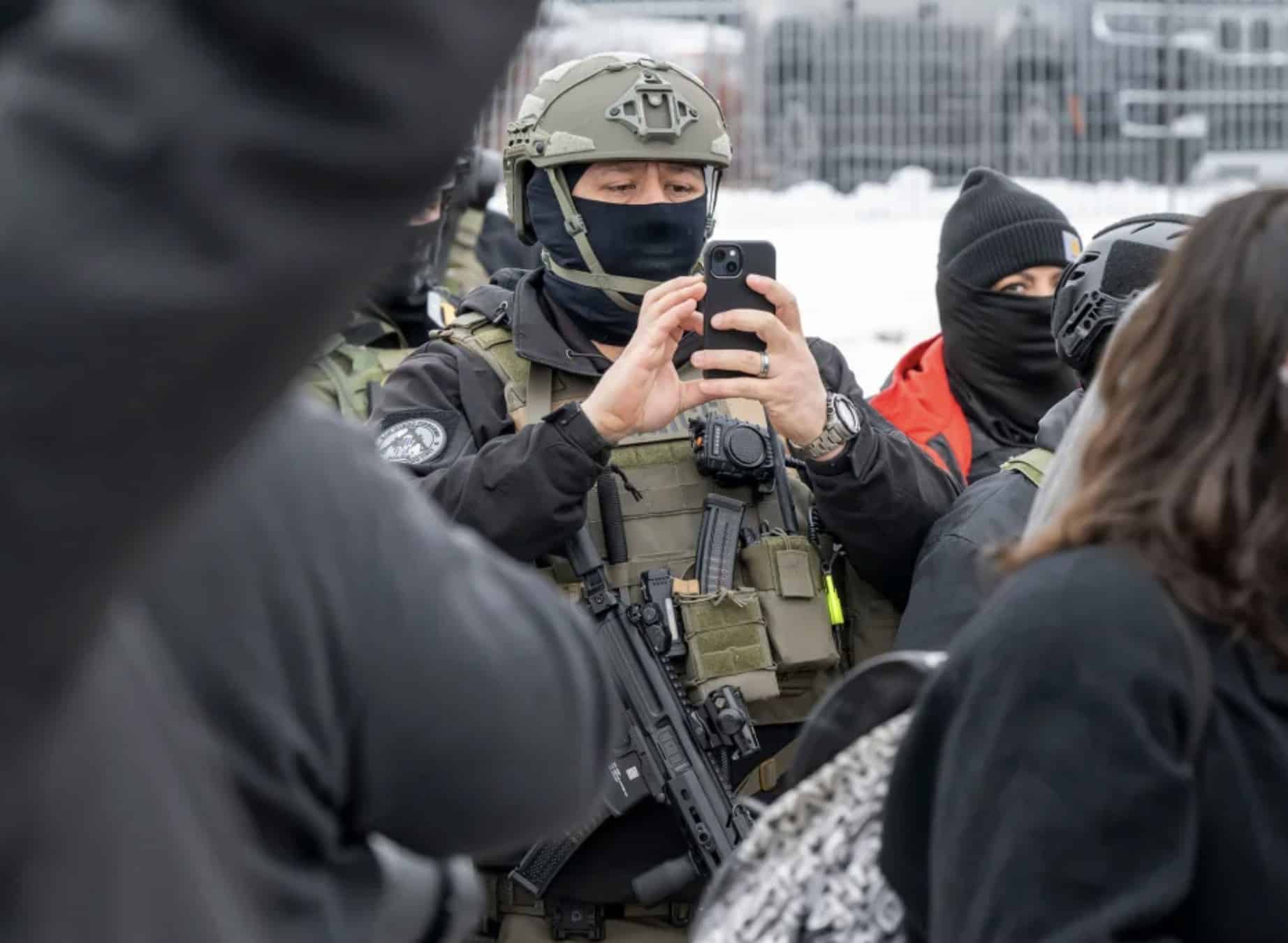
A group of congressional Democrats is demanding that the Department of Homeland Security (DHS) explain how they are using Palantir-developed technology and other surveillance tools in immigration enforcement.
The lawmakers argue that the systems may be helping power a broader “mass surveillance ecosystem” and are demanding answers about the “ongoing use of Palantir-developed technologies to collect Americans’ personal data to fuel a mass surveillance ecosystem.”
In a letter sent last week to DHS Secretary Markwayne Mullin and acting Immigration and Customs Enforcement (ICE) Director Todd M. Lyons – who announced he is resigning – the lawmakers said public reporting has raised serious questions about Palantir software being used to compile, aggregate, and analyze large volumes of personal data for immigration enforcement operations.
The lawmakers said DHS also appears to be using surveillance products from other contractors, including facial recognition tools from Clearview AI, social media monitoring software from PenLink, stingray technology from suppliers such as L3Harris, and cellphone surveillance technology built by Paragon Solutions.
“These data-compiling systems reportedly allow DHS personnel to link individual profiles to addresses, phone numbers, devices, and other identifying information across multiple datasets in order to generate leads and identify potential locations of persons sought for immigration enforcement actions,” the lawmakers said in the letter.
“The combination of facial recognition tools, social media surveillance, and large-scale data aggregation systems, and applications raise serious concerns about the operational use of personally identifiable information that belongs to individuals who are not suspected of any wrongdoing,” the lawmakers told Mullin.
“Specifically, these technologies are seemingly being weaponized against citizens, journalists, and individuals engaged in constitutionally protected activities, which include lawful assembly and protest,” wrote the lawmakers.
The push is being led by Reps. Dan Goldman and Nydia Velázquez, and Sen. Ron Wyden.
The letter points to reporting that Palantir-linked tools allow DHS personnel to connect individual profiles to addresses, phone numbers, devices and other identifiers across multiple datasets to generate leads and identify locations of people sought for immigration enforcement.
It also cites reporting and court testimony about an ICE application called Elite, which an agent described under oath as functioning “kind of like Google Maps” by showing neighborhoods or areas where a person might be located, while also acknowledging the tool could be wrong even when it expressed high confidence.
The lawmakers also highlighted what they described as a contradiction between those reports and recent public testimony by DHS and ICE officials. In the letter, they noted that Lyons said at February House and Senate oversight hearings that DHS does not have a database that tracks U.S. citizens.
They also pointed out that that then DHS Secretary Kristi Noem similarly told the House Committee on the Judiciary in March that the department was not creating a database of protesters.
The lawmakers said Congress has a responsibility to determine whether contractor-developed systems are being used in ways that comply with federal law and constitutional protections.
Their letter sets out 11 detailed requests for information and documents, with a response deadline of April 24.
Among other things, they want DHS to identify every database, analytics program, and application used by DHS, ICE and Customs and Border Protection to support immigration enforcement, and to specify whether each one was developed or maintained by Palantir or another private contractor.
They also requested a complete list of active and prior DHS-Palantir contracts since January 1, 2020, including contract values, performance periods, and the specific systems or functions supported under each agreement.
The letter further asks what government and commercial datasets feed into Palantir-developed systems; whether any DHS analytics tools collect or retain personally identifiable information belonging to U.S. citizens; what legal authorities DHS relies on to collect and keep that information; and what safeguards exist to limit retention and protect privacy.
The lawmakers are also seeking specific details about the use of facial recognition during immigration enforcement, including contracts with vendors, data retention practices, and any false positives or mistaken identifications.
The further want DHS to say whether it has collected or processed information about people peacefully observing, documenting or protesting immigration operations, and to provide a “comprehensive report” on the Elite application, including what categories of data it uses and how many DHS personnel are authorized to use it.
They also asked for a list of all private contractors providing surveillance or analytics technologies to DHS, as well as any internal guidance, memos, policies, or assessments governing those systems.
The congressional scrutiny comes amid broader attention on Palantir’s role in immigration enforcement central to the administration’s immigration crackdown and operating with insufficient transparency.
Separate federal procurement notices show ICE has pursued sole-source contracting actions tied to Palantir for Investigative Case Management and ImmigrationOS-related work.
“Congress has a clear and important role in exercising its oversight responsibility to ensure that use of contractor-developed data technologies complies with all relevant federal law while respecting applicable constitutional protections,” the lawmakers informed Mullins.
A controversial former plumber and short-lived Mixed Martial Arts wrestler from Oklahoma who auditioned for the role of DHS secretary, Mullins is expected to try stonewalling his former fellow lawmakers, setting himself up for what could be his first major clash with congressional Democrats.
In pressing for answers, the lawmakers are framing the issue not simply as a contract oversight matter but as a test of whether DHS’s expanding use of commercial surveillance and data fusion technology is outpacing privacy rules, transparency requirements, and constitutional guardrails meant to constrain it.
This pasta sauce wants to record your family
As if there weren’t already enough devices listening in on everything being said in your home, Prego, the pasta and pizza sauce brand, is releasing a device designed to record everything said around the dinner table for posterity. The Connection Keeper, which looks like an oversized pasta jar lid, was created in collaboration with StoryCorps, […]
British Lawmaker Caught Using AI-Generated Image of Fake, Deformed Supporters
Richard Tice, the deputy leader of Nigel Farage’s Reform UK, was caught using an AI-generated image of fake supporters with deformed faces.
The post British Lawmaker Caught Using AI-Generated Image of Fake, Deformed Supporters first appeared on Mediaite.


